
Frozen Time Capsules: What Antarctic Ice Drilling Reveals About Human-Caused Climate Change
Frozen Time Capsules: What Antarctic Ice Drilling Reveals About Human-Caused Climate Change
To truly understand where our planet’s climate is heading, scientists have had to travel to the coldest, most remote place on Earth—Antarctica. Beneath miles of solid ice lies the definitive proof of modern, human-driven climate change. By drilling deep into the ice sheet, researchers are uncovering a continuous, pristine record of Earth's atmosphere that stretches back over 800,000 years.
Here is how extracting ancient ice works, why it matters, and how it directly proves the link between human activity and global warming.
1. How Ice Cores Act as Nature's Time Capsules
Every year, snow falls over the Antarctic continent. Because it almost never melts, new snow continuously piles on top of older layers. Over thousands of years, the immense weight compresses the lower snow into solid glacier ice.
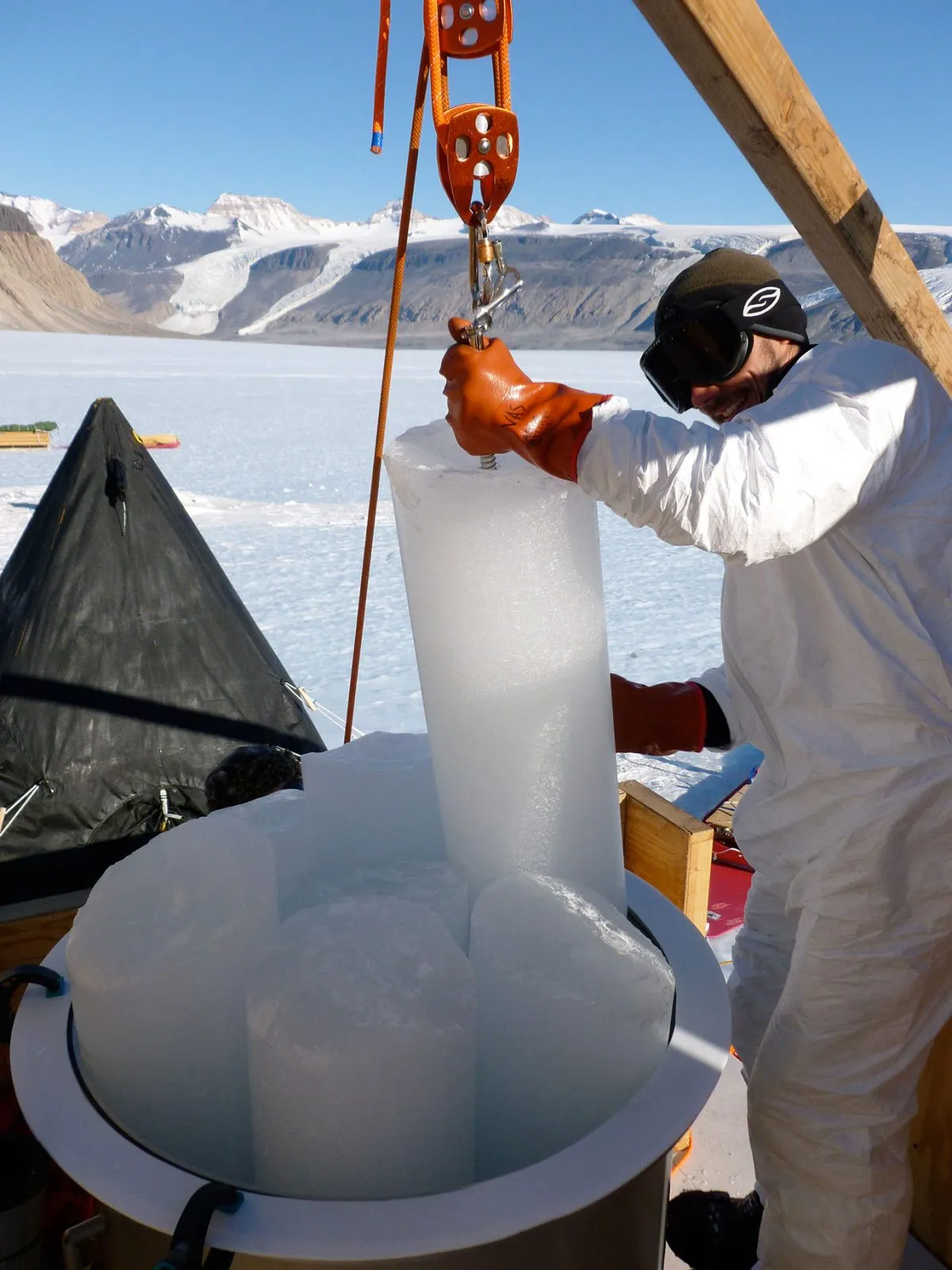
During this compression process, tiny pockets of atmospheric air get trapped inside the ice as sealed bubbles.When scientists drill thousands of meters down and pull up long cylinders of ice—known as ice cores—they are holding physical samples of the Earth's ancient air.
- Bubbles of Air: Provide direct, untouched samples of greenhouse gases like carbon dioxide (CO2) and methane (CH4) from hundreds of thousands of years ago.
- Water Isotopes: Ratios of hydrogen and oxygen isotopes in the frozen water act as a thermometer, allowing scientists to calculate the exact air temperature when that snow fell.
- Trapped Dust & Volcanic Ash: Reveal historical wind patterns, ocean spray, and major volcanic eruptions.
2. The Smoking Gun: CO₂ and Temperature Walk Hand-in-Hand
By carefully analyzing ice cores like the famous EPICA or Vostok cores from East Antarctica, paleoclimatologists mapped out natural climate cycles.
Over the last 800,000 years, Earth went through natural glacial (Ice Age) and interglacial (warm) periods. The ice core data reveals a direct pattern: whenever carbon dioxide levels went up, global temperatures rose with them. Whenever CO2 dropped, temperatures plummeted.
[ Natural Historical Range over 800,000 Years ] • CO₂ Minimum (Ice Ages) : ~180 ppm • CO₂ Maximum (Warm Periods): ~280-300 ppm [ Modern Era ] • Pre-Industrial Baseline : ~280 ppm • Present-Day Level : >420 ppm
3. How Ice Cores Prove "Man-Made" Global Warming
Skeptics often wonder if modern warming is just another natural Earth cycle. Antarctic ice cores provide three definitive facts that disprove this hypothesis:
- Unprecedented Speed and Levels: For 800,000 years, atmospheric CO2 never naturally exceeded ~300 parts per million (ppm). Since the Industrial Revolution, burning fossil fuels (coal, oil, gas) has spiked that number past 420 ppm. Ice core data shows this sharp increase matches the timeline of modern industrialization.
- Chemical Fingerprinting (Isotopes): Carbon comes in different isotopic forms (Carbon-12 vs. Carbon-13). Fossil fuels come from ancient plants, which prefer Carbon-12. By measuring the changing ratio of carbon isotopes trapped in recent ice and snow layers, scientists confirmed that the surge in $\text{CO}_2$ matches the exact signature of burning fossil fuels—not natural volcanic or ocean outgassing.
- The Rate of Change: Natural shifts of 80–100 ppm of CO2 historically took thousands of years during glacial transitions. Humans have driven a 140+ ppm spike in just 150 years.
Looking Ahead
Antarctic ice cores show that we have pushed our atmosphere far outside its historical boundary.Antarctica acts as both the planet's climate memory and an early warning system.Drilling deep into the ice gives humanity an undeniable truth: the current surge in global temperatures is driven by human activity, and understanding our past atmosphere is essential for predicting our planet's future.